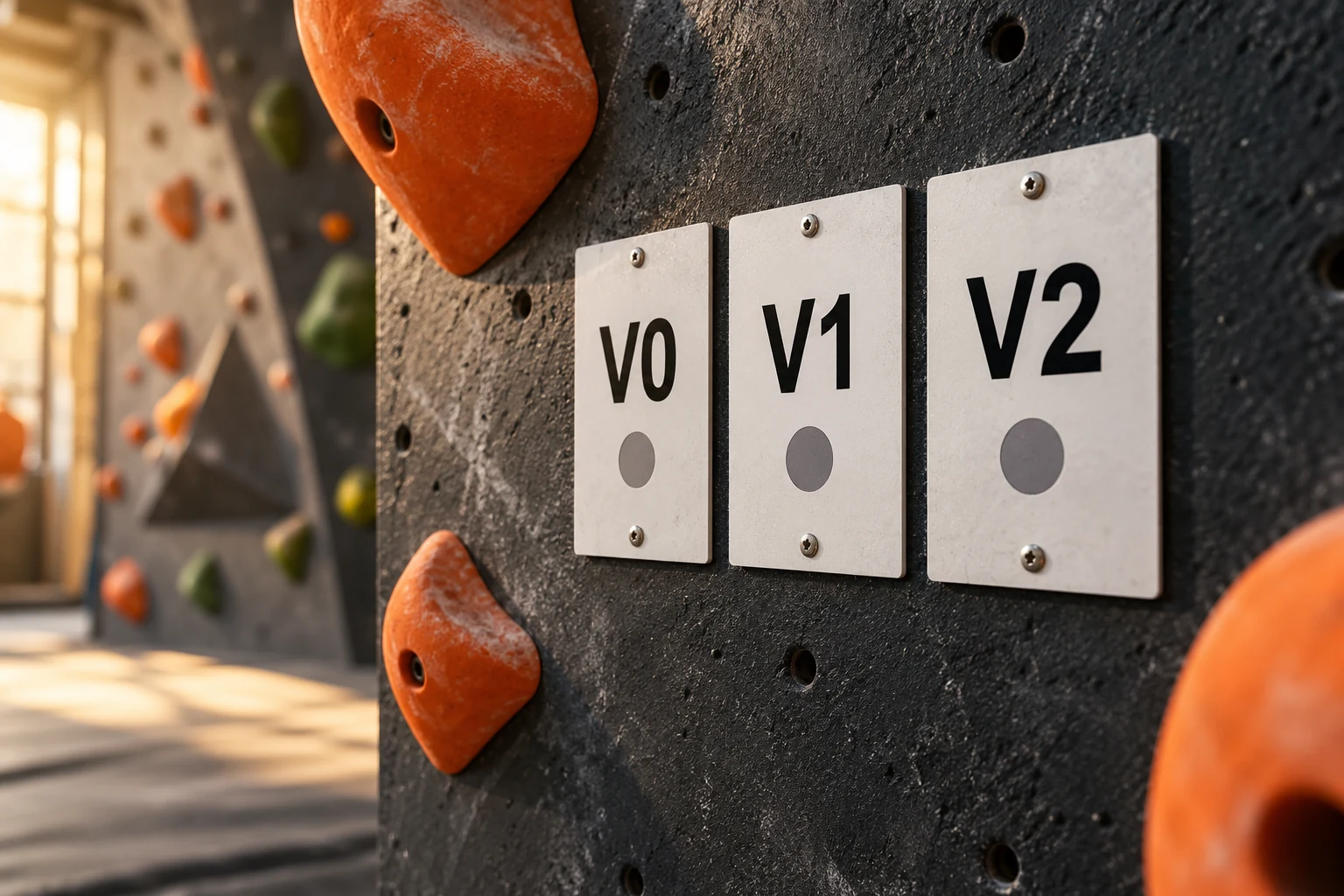
The V scale (V0, V1, V2…) grades bouldering problems: within the scale, a higher number means a harder problem, and VB or V0 is the usual starting point. Many indoor gyms group problems by color instead, and the color order differs from gym to gym, so read the gym’s legend first.
How do bouldering V grades work?
V0, V1 and V2 are examples of the V scale used for bouldering. Within that scale, a higher number indicates a harder problem. You may also encounter VB for introductory problems or symbols that distinguish difficulty within a grade.
A V grade is not a definitive score for someone’s experience or ability. Familiarity with movements, body type and problem style can affect how the same grade feels. On a first visit, combine staff guidance with the local markings.
Bouldering grade chart: V scale vs Font
The V scale and the Fontainebleau (Font) scale are the two most common bouldering grades. They split difficulty into steps of different sizes, so there is no exact one-to-one conversion. The chart shows approximate ranges by level.
| Level | V scale | Font |
|---|---|---|
| Beginner | V0–V2 | 4–5+ |
| Intermediate | V3–V5 | 6A–6C+ |
| Advanced | V6–V8 | 7A–7B |
| Expert | V9–V12 | 7B+–8A+ |
At lower grades a single V grade often spans several Font grades. Do not use this chart to compare with roped grades such as 5.10a or 6a. See how to read gym colors below.
5.10a and 6a belong to different systems.
V scale
Examples: V1 and V2, used for bouldering problems.
Numbers starting with 5
Examples: 5.10a and 5.10b, used for technical difficulty in roped climbing.
Numbers and letters
Examples: 6a and 6b, French sport-climbing grades.
These values illustrate notation, not equivalent difficulty. Do not use a single fixed conversion between bouldering and roped-climbing grades to select a climb. Grades can also vary across regions and gyms within one system.
Distinguish hold colors from difficulty colors.
Hold colors may identify which holds belong to one problem. Difficulty might instead be shown by tape or a sign at the start. You cannot reliably interpret a color before reading the facility’s legend.
Ask two separate questions: “What level does this color represent?” and “How are this problem’s usable holds marked?”
If the gym does not provide an official V grade for its color level, record the gym and its actual marking instead of inventing a V-grade equivalent.
How to read a gym color chart
- Find the legend near the entrance, front desk or wall that lists the color order and levels. A photo makes later visits easier to compare.
- If the legend shows a V-grade range for each color, record both the color and the range.
- Problems within one color can feel different. Try several in a color before moving to the next level.
- Another gym may use a different color order. Record the gym name together with the color.
How should you choose an introductory problem?
- After the introductory briefing, ask staff which areas and problems are appropriate for you.
- Check local instructions for start and finish markings and the way down.
- Share turns and rest between attempts before deciding what to try next.
- Note difficult sections and familiar movements. One grade does not describe your entire session.
This page explains difficulty markings. Landing and rope-belay skills require hands-on instruction.
Examples of useful grade records
Example A: Bouldering / V scale / V2 / first and second attempts on the same problem.
Example B: Bouldering / gym color chart / blue / recorded after checking that day’s local chart.
These examples are not equivalent grades. A new route setting may produce a different problem with the same color.
In ClimbCut, you can choose a discipline and grade before recording and use that metadata to find a saved video. Choosing a grade is optional and does not block recording.
Use grade badges and library filters →Sources and further reading
- REI: Climbing and Bouldering Rating Systems: V grades, YDS and regional or personal variation
- BMC: Indoor climbing grades explained: grading systems
- 99Boulders — Bouldering Grades: The Complete Guide: approximate V and Font ranges by level
- Mammut — Bouldering difficulty scales explained: why conversions are approximate
Sources checked November 4, 2026. This guide compares approximate V and Font ranges for bouldering only. It does not provide an exact conversion, a bouldering-to-roped conversion or a universal gym color chart.