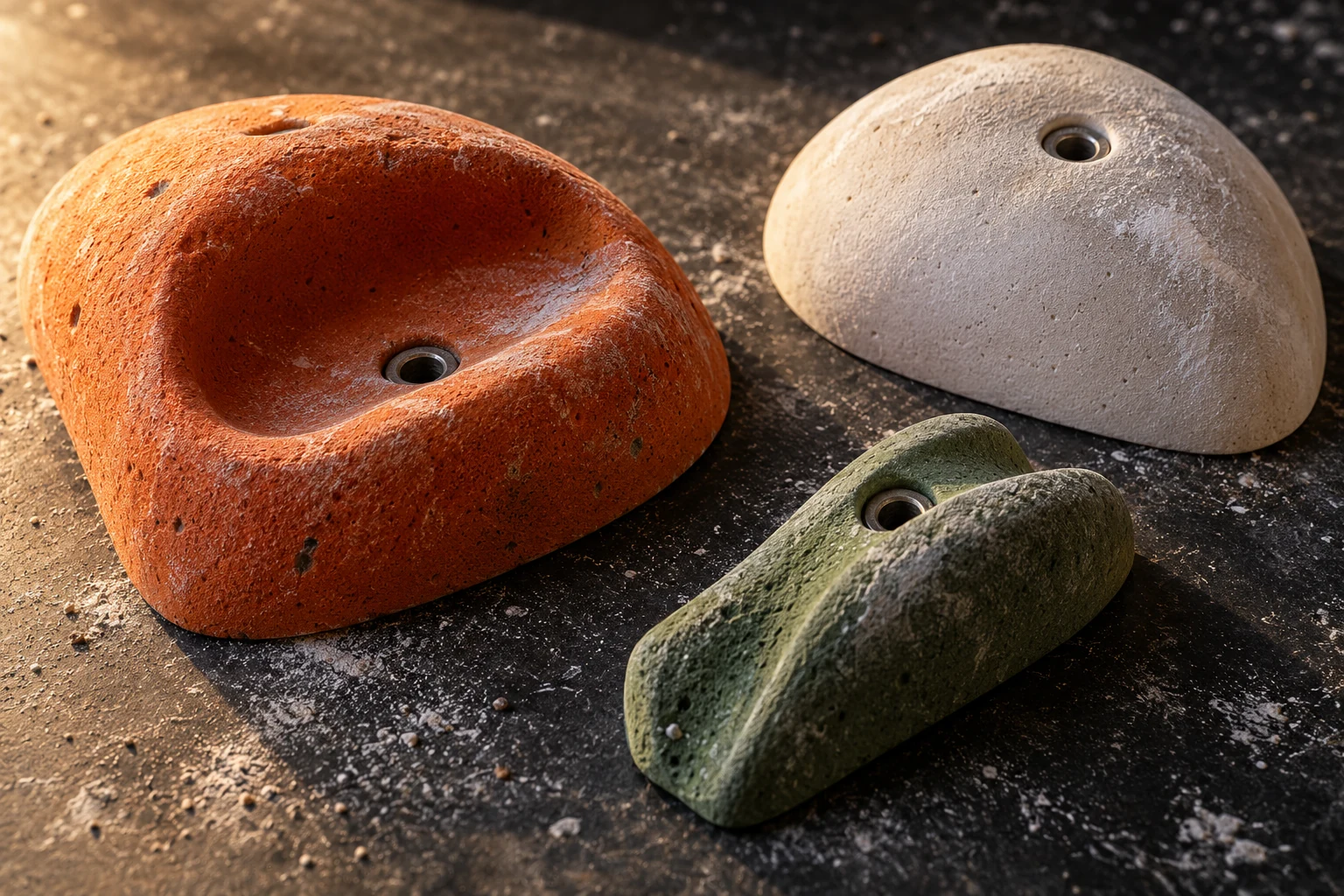
At the wall: holds, problems and starts. When discussing movement: moves, beta and cruxes. When recording an attempt: sends and flashes.
Words you hear at the wall
- Hold
- A place to grip with a hand or stand on with a foot. Indoors, this usually means an artificial hold attached to the wall.
- Problem / Route
- A climbing task from start to finish. “Problem” is commonly used for bouldering and “route” for roped climbing.
- Start / Top
- The beginning and end of a climb. Check local markings and instructions for starting hand positions and finishing requirements.
- Slab / Overhang
- A slab leans away from the climber as it rises. An overhang projects toward the climber. Both differ from a vertical wall.
Words for movement and information
- Move
- A movement to the next position. A problem links several moves together.
- Beta
- Information about movements or sequences for solving a climb. Watching a video can provide beta.
- Crux
- A particularly difficult move or section of a problem or route.
- Matching
- Using the same hold with both hands, for example. Understand the movement separately from a finish hold’s official completion requirements.
Some people prefer not to receive beta. Ask before explaining a sequence or showing a video.
Words for reviewing an attempt
- Send / Completion
- Completing a problem or route according to its requirements. Check the discipline and local start and finish rules.
- Flash
- Completing a climb on the first attempt without falling or resting on the rope; prior beta may have been available.
- Onsight
- Completing a climb on the first attempt without falling, resting on the rope or receiving prior beta. This differs from having already gained information through a video, for example.
- Project
- A problem or route you are working on over repeated attempts.
What do these expressions mean in context?
The climber could not move past a difficult section. It does not necessarily mean the problem had a higher grade.
This asks before offering a solution. Thinking through a problem independently can be part of the experience.
When organizing videos, separate the result—such as completing the climb—from an observation about a particular movement. An unsuccessful attempt can still be useful to revisit.
Find videos by discipline and grade →Sources and further reading
- Mountain Training: Rock climbing glossary: beta, crux, flash, onsight and other terms
- REI: Rock Climbing Glossary: problems, routes and movement
- REI: Bouldering Basics: wall angles
ClimbCut edited the explanations and examples for beginners. They do not replace competition judging or gym rules. Sources checked October 23, 2026.