Choose a discipline → check lessons and rentals → attend the gym briefing → try introductory problems → review your experience.
What is climbing?
Climbing means finding handholds and footholds to move up a wall or rock. Indoors, you use artificial holds attached to a wall, linking movements as you decide where to reach and which foot to stand on.
You will encounter bouldering, lead and speed: different sport climbing disciplines. Before an indoor visit, check which activities and introductory lessons the facility actually offers.
How do bouldering, lead and speed differ?
Work through shorter problems
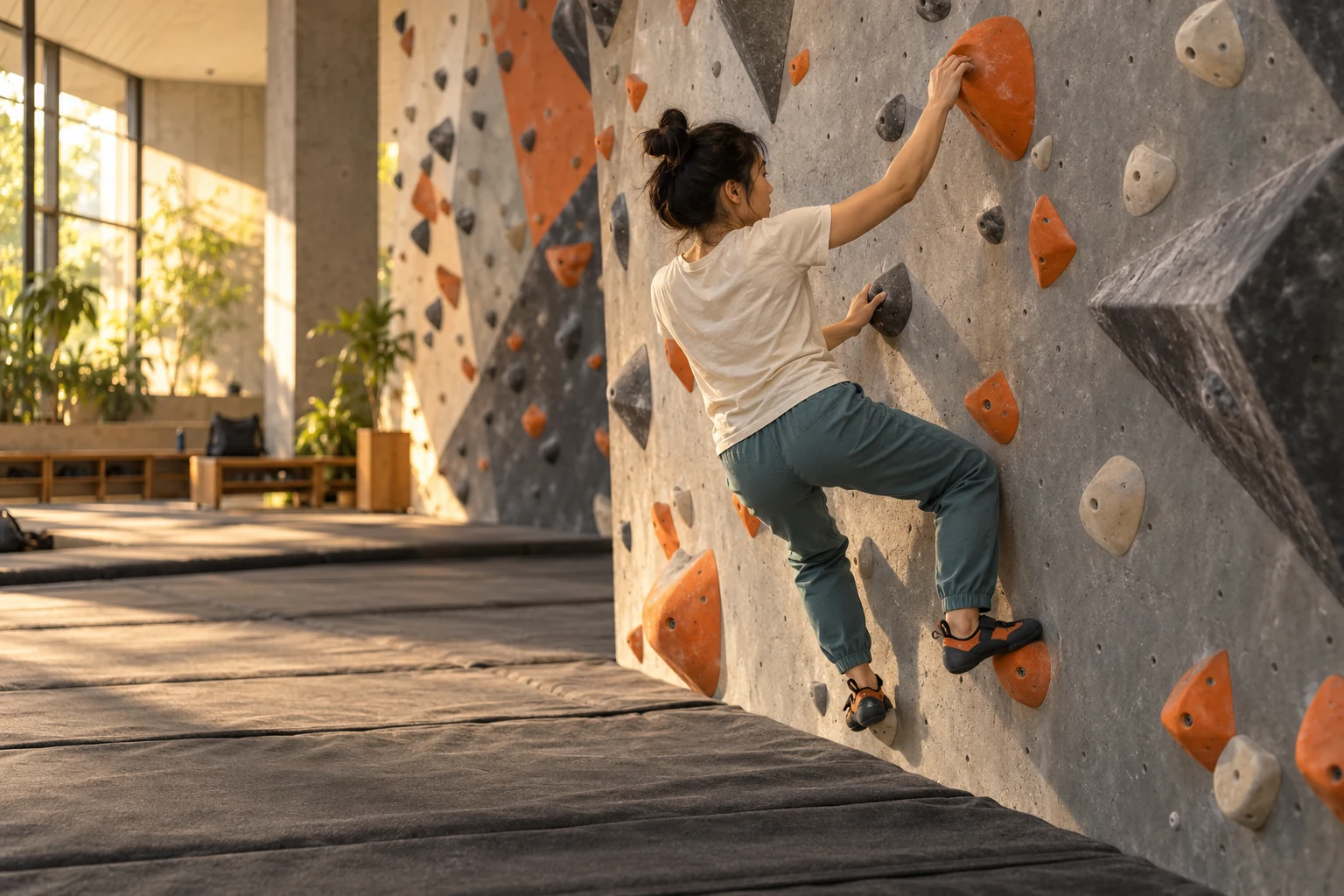
Bouldering uses relatively low walls without ropes. Follow the facility’s mat and safety guidance; mats do not remove every landing risk.
Climb with rope protection
In lead climbing, you clip the rope into protection as you climb. Equipment use and belaying require separate instruction. This differs from a top-rope introduction, where the rope already runs through an anchor above.
Race on a standardized route
Speed climbing measures how quickly a climber completes a standardized course. It differs from solving ordinary gym bouldering problems.
Discipline references: World Climbing Boulder, Lead and Speed. Competition scoring and recreational gym rules are separate matters.
Bouldering or top-rope for your first session?
Indoor gyms offer different activities. Choose what interests you, then check the facility’s introductory sessions and instruction requirements.
| Activity | Ropes and equipment | Ask before booking |
|---|---|---|
| Bouldering | Solve problems on lower walls without a rope or harness. Indoor mats and climbing shoes are used. | Does the visit include an orientation on downclimbing, landing and where to wait? |
| Top-rope | Use a harness and a rope running through an anchor above the climb. | Who belays during the introduction? Are equipment rental and instruction included? |
| Lead | Clip the rope into protection as you climb, using a harness and belay equipment. | What prior training, belay checks and partner arrangements are required? |
Top-rope and lead are different forms of roped climbing. A session using a rope is not necessarily lead climbing. Learn equipment use and belaying through hands-on instruction.
Discipline and equipment reference: REI — Getting Started Rock Climbing
New to climbing: what should you learn beyond arm strength?
Climbing combines foot placement, balance and movement sequences with pulling strength. Ask about these three ideas in your first lesson, then observe them on an introductory problem chosen with your instructor.
- Foot placement
- Did you look for footholds as well as the next handhold? Learn how to use them through hands-on instruction.
- Balance
- How did your feet and body position change before and after moving a hand? Show that moment to your instructor and ask about it.
- Sequence
- Did your attempt follow the sequence you planned on the ground? Notice one change rather than focusing only on a higher grade.
Footwork and balance concepts: REI Climbing Techniques and Moves. Source checked October 25, 2026.
Ask these five questions before your first visit.
- Can a first-time visitor take part? Check introductory lesson bookings, start times and permitted areas.
- Can I rent climbing shoes? Ask about availability, sizes and requirements such as socks.
- What is the total cost? Check whether instruction and rentals are included, along with session limits and re-entry conditions.
- What should I wear and bring? Bring comfortable clothing and water, and check the facility’s rules for clothing, jewelry and personal equipment.
- What must I learn on arrival? Ask staff about movement around the facility, route markings, downclimbing and landing guidance. Ropes and auto-belays require their own training and checks.
Prices and booking procedures differ between gyms and branches. Use the selected facility’s current official information instead of an old review’s prices.
Open the first-visit checklist →Once you have the admission, instruction and rental fees, use the first-visit cost calculator to total one visit. Count included items only once.
Identify the grading system before comparing colors.
You may see V grades for bouldering and YDS or French grades for roped climbing. In a gym with color levels, start with its own chart. Do not assume the same color means the same difficulty in another gym.
Ask staff for introductory problems instead of choosing a target number immediately. A climb’s movement, wall angle and your familiarity with its style can change how a grade feels.
Read V grades, colors and roped-climbing grades →Four useful words for following an explanation
- Hold
- A place to grip with a hand or stand on with a foot.
- Problem or route
- A climbing task linking a start to a finish.
- Move
- A movement to the next position.
- Beta
- Information about movements or sequences that help solve a climb. Ask whether someone wants advice before sharing it.
Review your first climbing video in three lines.
Use this ClimbCut worksheet to compare two attempts on the same problem. Separate the result from what you observed and keep one question for your next lesson.
Edit this note on this page only. It is not sent to a server or saved automatically; reloading resets it. Copy the text and save it yourself if you want to keep it.
Your first record does not have to be a successful send.
Keep a note of where you stopped and what you want to try next. When comparing two videos of the same problem, check that both show the start and the path of your hands and feet, rather than looking only at the grade.
Before filming, check the gym’s rules and the wishes of anyone who may appear or be recorded. Place phones and tripods only in permitted positions clear of landing areas, mats and walkways. A better camera angle is not a reason to block another climber’s path.
ClimbCut, which publishes this website, is an app for recording, organizing and editing climbing videos. You can read these guides and use the checklist without installing the app.
Common beginner questions
Can I visit on my own?
Check whether the gym accepts individual bookings for introductory sessions. Bouldering does not use a rope belay partner, but that does not mean you can skip the first-use briefing.
Must I buy climbing shoes for the first session?
If the gym offers rentals, you can try rented shoes first. Follow its sizing and fitting advice and confirm its rental requirements.
Are red problems equally difficult at every gym?
No such comparison can be assumed. First check whether color identifies a problem or a difficulty level, then use the local chart.
Can I start lead or outdoor climbing after reading this?
This is a guide to disciplines and visit preparation. Rope systems, belaying and the skills needed outdoors must be learned through appropriate instruction and hands-on training.
Sources and editorial information
ClimbCut checked public resources and developed the questions and recording workflow for beginners. The organizations below have not reviewed or endorsed this article or app. Check individual facilities for current prices, lessons and grading charts.
- World Climbing Boulder, Lead, Speed: discipline distinctions
- REI: Getting Started Rock Climbing: indoor introductions and training
- REI: Bouldering Basics: indoor bouldering and rentals
- REI: Climbing and Bouldering Rating Systems: grades and their variation
- Mountain Training: Rock climbing glossary: terminology
Sources checked October 23, 2026 · Suggest a correction